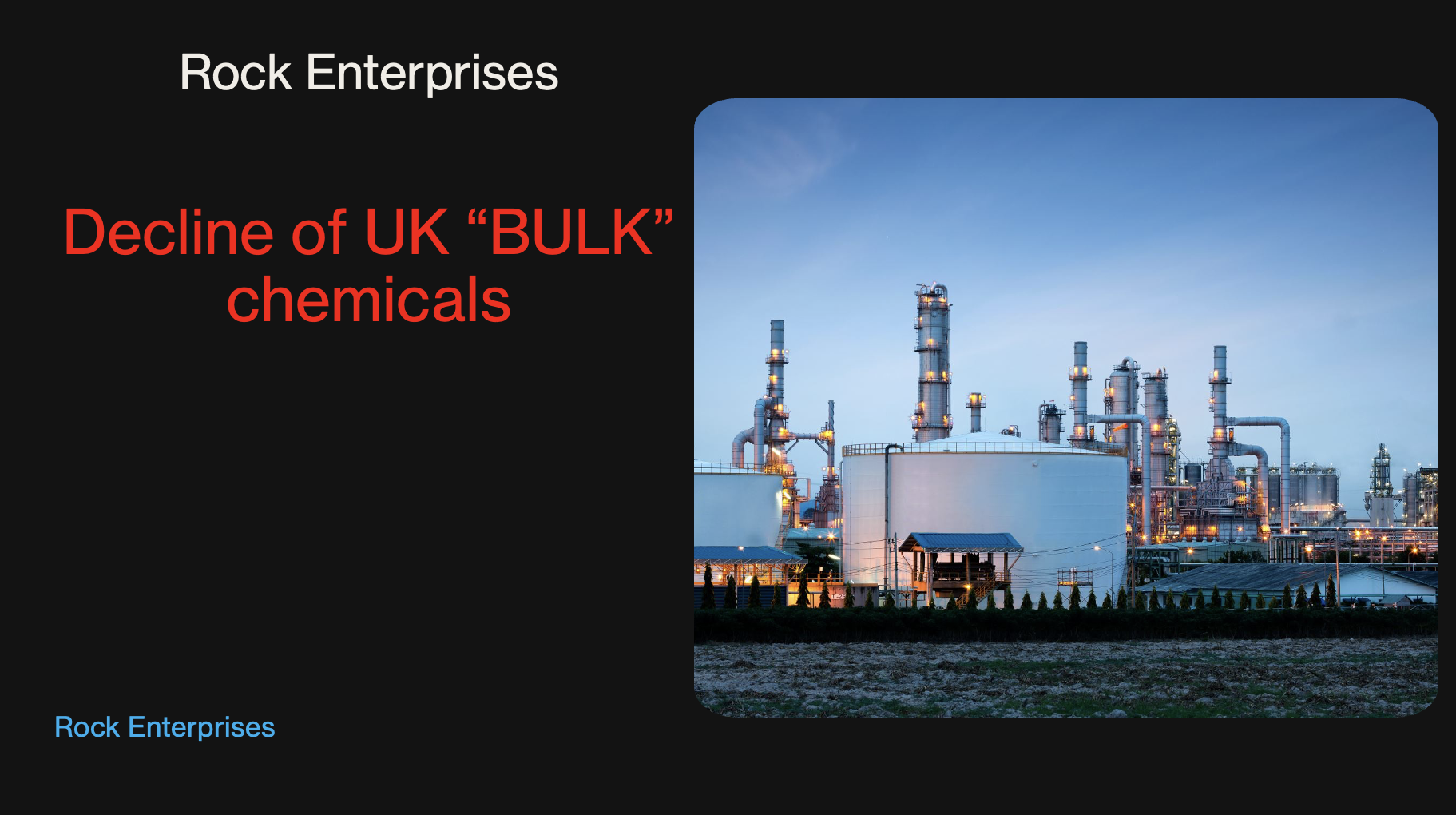
Over the last 25 years, the UK chemical industry has become more concentrated in a handful of industrial clusters, rather than being evenly spread across the country.
Traditional distribution
Historically, the industry was concentrated in locations with:
- Access to ports for importing raw materials.
- Proximity to oil and gas feedstocks.
- Good transport links (rail, road and pipelines).
- Nearby heavy industry customers such as steel, plastics and manufacturing.
As a result, the largest chemical centres developed in:
| Region | Major Centres | Main Activities |
|---|---|---|
| North East England | Teesside | Petrochemicals, industrial gases, bulk chemicals |
| North West England | Runcorn, Ellesmere Port, Widnes | Chlor-alkali chemicals, pharmaceuticals, specialty chemicals |
| Yorkshire & Humber | Hull, Saltend Chemicals Park | Petrochemicals, plastics, industrial chemicals |
| Scotland | Grangemouth | Refining, petrochemicals, polymers |
| South Wales | Milford Haven, Baglan | Petrochemicals and downstream chemicals |
| East of England | Various pharmaceutical sites | Pharmaceuticals and biotechnology |
How the distribution has changed since 2000
1. Decline of bulk commodity chemicals
The UK has lost some traditional large-scale commodity chemical production because:
- Energy costs have risen relative to competitors in the Middle East and North America.
- Global production shifted toward regions with cheaper feedstocks.
- Some older plants became less competitive.
This particularly affected parts of Teesside and Grangemouth.
2. Growth of specialist chemicals
Rather than competing on volume, many UK firms moved into:
- Speciality chemicals
- Pharmaceuticals
- Biotechnology
- Advanced materials
- Consumer and personal-care chemicals
These tend to employ fewer people but generate higher value.
3. Cluster effect
Chemical companies increasingly locate near each other because they can share:
- Pipelines
- Utilities
- Skilled labour
- Research facilities
- Logistics infrastructure
This has strengthened major clusters such as:
- Teesside
- Humber/Saltend
- Runcorn-Ellesmere Port
- Grangemouth
while smaller standalone sites have become less common.
Regional winners and losers
Winners
- North West England (particularly pharmaceuticals and speciality chemicals)
- East of England and South East (life sciences and biotech)
- Humber region (industrial chemicals and renewable fuels)
Under pressure
- Grangemouth and some petrochemical assets in Scotland
- Parts of Teesside that depended on commodity chemicals
- Older chemical sites linked to declining heavy industry
Current pattern
Today the UK chemical industry can be thought of as having two geographic centres:
- The northern industrial corridor (Teesside, Humber, Cheshire, Merseyside and Grangemouth) focused on bulk chemicals, petrochemicals and industrial feedstocks.
- The southern and eastern life-sciences corridor (Cambridge, Oxford, London, Hertfordshire and surrounding areas) focused on pharmaceuticals, biotechnology and research-intensive chemical products.
What has happened?
The UK has lost some commodity chemical production over the past 25 years, particularly in energy-intensive sectors. However, revenue has been partly supported by growth in:
- Pharmaceuticals
- Speciality chemicals
- Biotechnology
- High-value advanced materials
As a result, output volumes have often fallen while revenue has remained relatively resilient because the products sold are higher value.
Recent evidence
The Chemical Industries Association reported that UK chemical-sector output in 2023 contracted by 10.1% and by May 2024 was 23.2% below pre-pandemic levels.
Despite this decline in physical output:
- The UK chemical and pharmaceutical sector still generated around £82 billion of turnover in 2025.
- It contributed approximately £38 billion of value added to the UK economy and remained the UK’s second-largest manufacturing industry.
- UK chemical industry revenues were reported at roughly £62 billion in 2023, even during a period of falling production.
Why revenue has not fallen as much as production
Think of it this way:
| Traditional model | Modern model |
|---|---|
| Large volumes of bulk chemicals | Smaller volumes of specialist products |
| Lower profit margins | Higher margins |
| Energy-intensive production | Knowledge-intensive production |
| Competes mainly on cost | Competes on technology and intellectual property |
For example, producing basic petrochemicals generates relatively low margins, whereas pharmaceuticals and speciality chemicals can generate significantly more revenue per tonne of product.
Regional impact
The decline has been felt most in:
- Teesside bulk chemicals
- Grangemouth petrochemicals
- Older manufacturing complexes in northern England and Scotland
At the same time, growth has shifted toward:
- Cheshire and the North West (speciality chemicals)
- Cambridge-Oxford life sciences corridor
- Pharmaceutical clusters around the South East
In summary
Over the last 25 years, the UK’s chemical industry has shrunk in terms of traditional bulk production capacity, but the decline has been partly offset by a move into higher-value products. Revenue has therefore not fallen in proportion to production. The sector still generates tens of billions of pounds annually, yet it produces less volume than it did historically and faces increasing competition from regions with lower energy costs, such as the US Middle East and parts of Asia.